Le strade del gusto
Sardinia told through its flavors.
Authentic food and wine experiences to discover the wine, oil, cheeses, craft beer, fresh pasta and the traditions of Sardinia.
Made with ❤️ in Sardinia
Wine
Le strade del gusto - P. Iva 03790590925 - @All Right Reserved 2026
Sardinia Told Through Its Flavours
Sardinia is much more than a place to visit. It is an island to experience, to listen to and to savour.
Its unique identity has been preserved over the centuries thanks to its geographical isolation, which has safeguarded ancient traditions, artisanal craftsmanship and one of the Mediterranean's richest gastronomic heritages. Here, food is far more than nourishment—it is culture, memory and one of the most authentic ways to discover the island.
At Le Strade del Gusto, we invite you to experience Sardinia through its flavours, the people who create them and the stories that make them truly unique.
Sardinia's Wine Heritage
Sardinia is one of the oldest wine-producing regions in the Mediterranean. Vine cultivation on the island dates back thousands of years and has been shaped over the centuries by the many civilizations that settled here, from the Phoenicians and Romans to the Aragonese.
Today, Sardinia preserves an extraordinary wine heritage, built on native grape varieties, unique landscapes and a wine culture deeply rooted in the island's history and traditions. Its diverse soils, Mediterranean climate, constant sea breezes and proximity to the coast all contribute to wines with distinctive character, each reflecting the unique identity of its territory.
From the rolling hills of the Parteolla to the vineyards of Sulcis, from the mountains of Barbagia to the coastal landscapes of Gallura, every corner of the island offers its own interpretation of wine, born from the perfect balance between nature, tradition and the dedication of its producers.
Today, this remarkable heritage is enhanced by prestigious appellations and wineries that combine respect for tradition with innovation, sustainability and hospitality, making Sardinia an increasingly popular destination for wine lovers and wine tourism enthusiasts.
🍇 More than 2,000 years of winemaking history
🌿 More than 20 native grape varieties
🍷 1 DOCG and 18 DOC appellations
🌍 One of the Mediterranean's richest wine biodiversities
Sardinia's Native Grape Varieties
Sardinia is home to one of the richest ampelographic heritages in the Mediterranean. Alongside internationally renowned grape varieties, the island has preserved a remarkable collection of native grapes that reflect the history, biodiversity and identity of its diverse territories.
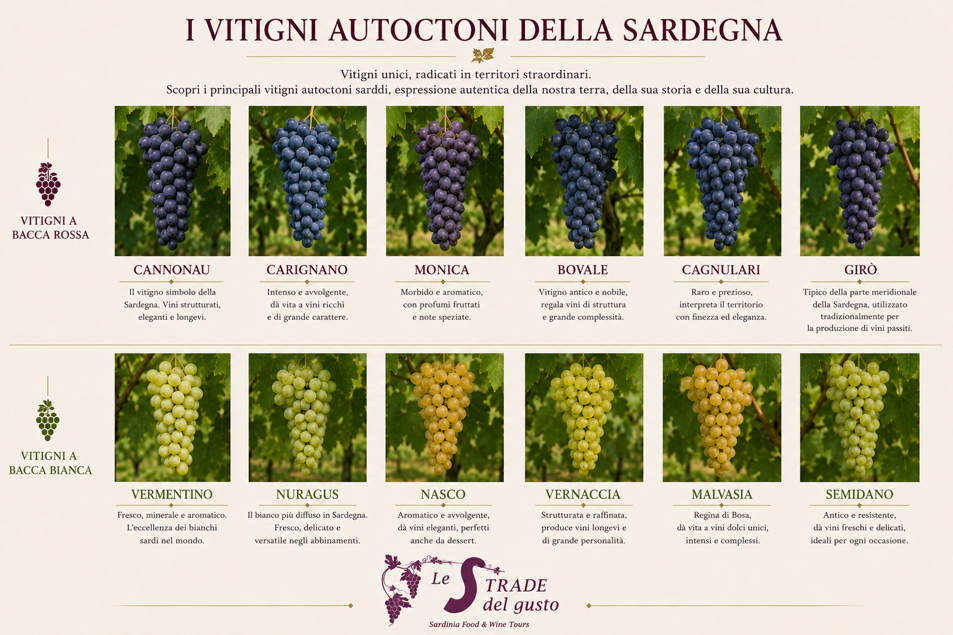
Cannonau, Vermentino, Carignano, Monica, Bovale, Nuragus, Nasco, Vernaccia di Oristano, Semidano and many other native varieties represent a unique heritage, shaped by centuries of cultivation and by a deep connection with the island's climate, soils and traditions.
Each grape variety expresses its own distinctive character, giving life to wines with unmistakable aromas, flavours and personalities. Discovering them means embarking on a journey through Sardinia's different wine regions and understanding how every wine is the result of the perfect balance between nature, culture and human craftsmanship.
Bovale
Red grape variety from which a wine is obtained that was once used only as a blend in the Campidano area. Today it is also vinified as a single varietal, reaching excellent quality levels, especially in the Terralba area. It has an intense ruby red color, fruity aromas with hints of ripe plum and wild berries. It has good structure, although it is mainly characterized by its rusticity. It pairs well with meat-based dishes.
Cannonau
It is certainly the most important red grape variety in Sardinia and one of the best known outside the island. It is grown throughout the territory, although it presents different characteristics depending on the area of origin. The wine obtained has a transparent, ruby color with violet reflections in its youth, intense and fruity aromas with hints of plums and blackberries. It pairs well with red meats and aged cheeses.
Carignano
It is a red grape variety, resistant to sea winds and grows well along the southwestern coasts of the island. The wine obtained from this grape has an intense ruby red color, a fruity, floral aroma with herbaceous notes that tend to evolve into spicy notes. It pairs excellently with roasted meats and aged cheeses.
Cagnulari
This red grape variety, present for centuries in Sardinia, is grown almost exclusively in the Sassari area. In the past, the wine obtained was often used to blend with other red wines that were less intense and full-bodied. Cagnulari was saved from extinction only thanks to the tenacity of about ten small producers who believed in the grape variety. It generally has a ruby red color and fruity aromas. Low in tannins and with good structure, it pairs well with meats and aged cheeses.
Girò
This red grape variety was widely grown in southern Sardinia, and its origins probably date back to the Spanish domination. Due to its irregular productivity, it was almost completely abandoned in favor of less problematic varieties. Its production has been revived, although only to a limited extent, only recently. It is usually used to produce wines with residual sugar that pair well with desserts and aged cheeses.
Malvasia
White grape variety cultivated throughout Sardinia, although the most renowned Malvasia is produced in Bosa. The resulting wine is golden with amber reflections, with very intense aromas of ripe and dried fruit. It pairs perfectly with almond paste-based desserts. Also excellent on its own as a meditation wine.
Monica
Red grape variety of distant Spanish origin. It is grown throughout Sardinia. From this grape variety, an intensely ruby red wine is obtained, with pronounced, vinous aromas and moderate acidity. Often used in blends to give a soft character. It pairs well with structured dishes.
Moscato
This aromatic white grape variety is grown throughout the island, with a prevalence in the Cagliari area. The resulting wine has intense aromas of honey, dried fruit, dried fig, and apricot. It pairs well with dry pastries or blue and aged cheeses. Also excellent as a meditation wine.
Nasco
This is an indigenous white grape variety, cultivated mainly in the Campidano area. Usually used for the production of sweet wines, today it is also successfully vinified as a dry wine. The sweet type pairs perfectly with almond-based desserts, while the dry type goes well with fish dishes and white meats.
Nuragus
It is the most widespread white grape variety in Sardinia, where it seems to have been introduced by the ancient Phoenicians. The resulting wine is straw yellow in color with delicate fruity aromas (apple, acacia flowers). Fresh and easy to drink, it pairs well with seafood and fresh Sardinian pecorino cheese.
Semidano
It is an indigenous white grape variety mainly grown in the Mogoro area, in the province of Oristano. The resulting wine has an intense straw yellow color, with a fruity aroma and a dry, savory flavor. It pairs well with white meats and seafood soups.
Torbato
This white grape variety definitely has Spanish origins and is mainly cultivated in the Alghero area. It is used to produce dry wines and in some cases is made sparkling. It has a pale straw yellow color, with fruity, floral, and vegetal aromas. It pairs well with dishes based on shellfish and mollusks.
Vermentino
It is the white grape variety from which the only DOCG of Sardinia is obtained. Its cultivation is widespread throughout the island, but it is in Gallura, where it was planted at the end of the 19th century, that it found its perfect terroir, thanks to the granite nature of the soil. Usually, the resulting wine has a straw yellow color, vegetal aromas of Mediterranean scrub, and notes of white-fleshed fruit. Its characteristic finish in the mouth is almondy. It pairs well with fish dishes, even fairly elaborate ones.
Vernaccia
This white grape variety has very ancient origins, to the point of being considered native. The production of Vernaccia is allowed only in the province of Oristano. It is obtained with an oxidative method similar to that of Jerez, using surface film-forming yeasts called "flor." It presents a golden yellow color with amber reflections, with a very intense aroma of dried fruit and spices. In the dry vinified version, it is suitable for aperitifs or fish-based dishes. A traditional pairing is with bottarga. In the version with residual sugar, it pairs well with dry pastries.
Sardinia's Wine Regions
The richness of Sardinian wine stems from the extraordinary diversity of its landscapes. From vineyards overlooking the sea to the rolling hills of the inland countryside, each wine region has its own unique character, shaped by climate, soils, altitude and local traditions.
Exploring these territories means discovering the true soul of Sardinia through wines that reflect the places where they are born.
Gallura
Located in the north-east of Sardinia, Gallura is home to Vermentino di Gallura DOCG, the island's only DOCG appellation. Its granite soils and proximity to the sea produce elegant white wines with remarkable freshness and pronounced minerality.
Sulcis
Situated in the far south-west of the island, Sulcis is the homeland of Carignano del Sulcis DOC. Here, vineyards often grow on sandy soils close to the sea, producing rich, smooth and age-worthy red wines.
Parteolla
In the heart of southern Sardinia, Parteolla has long been one of the island's most important wine-growing areas. Vermentino, Cannonau, Monica, Nuragus and Moscato are cultivated here alongside other native and international grape varieties.
Campidano
Sardinia's largest plain is home to numerous wineries. Its favourable climate supports the cultivation of several grape varieties, including Monica, Nuragus, Vermentino and Cannonau, producing balanced and versatile wines.
Trexenta
A land of gentle hills in south-central Sardinia, Trexenta boasts an ancient agricultural tradition in which vine growing has always played a central role. Cannonau, Monica, Vermentino, Nuragus and Bovale thrive here, benefiting from limestone and clay-rich soils that give the wines elegance and balance.
Marmilla
Marmilla is characterised by rolling hills and marl-rich soils, from which the region takes its name. Winemaking is deeply rooted in local culture and produces authentic wines that express a strong connection with the land. Cannonau, Monica, Bovale, Vermentino and Nasco are among the area's most widely grown grape varieties.
Mandrolisai
In the heart of the island lies the Mandrolisai DOC, traditionally produced from a blend of Cannonau, Bovale and Monica. These wines are structured, elegant and deeply rooted in Sardinian winemaking traditions.
Ogliastra
A land of mountains and sea, Ogliastra is considered one of the birthplaces of Cannonau. Significant day-to-night temperature variations and the proximity of the coast give its wines remarkable character and aromatic intensity.
Barbagia
The historical heart of Sardinia, Barbagia preserves a long-standing winemaking tradition. Here, Cannonau reaches some of its finest expressions, producing complex, age-worthy wines full of personality.
Romangia
A small wine region in north-western Sardinia overlooking the Gulf of Asinara, Romangia is known for Vermentino, Cannonau and Cagnulari, grown on limestone soils under the constant influence of sea breezes.
Planargia
Located along the western coast, Planargia is the homeland of
Malvasia di Bosa DOC, one of Sardinia's most prestigious sweet wines. Vineyards nestled between hills and the sea produce elegant, complex wines steeped in history.
Sardinia's Main Wine Appellations
Regional Wine Appellations
Central Sardinia
Southern Sardinia
Mandrolisai DOC
Cannonau di Sardegna DOC
Monica di Sardegna DOC
Vermentino di Sardegna DOC
Moscato di Sardegna DOC
Sardegna Semidano DOC
Cagliari DOC
Carignano del Sulcis DOC
Girò di Cagliari DOC
Nasco di Cagliari DOC
Nuragus di Cagliari DOC
Campidano di Terralba DOC
Western Sardinia
Northern Sardinia
Arborea DOC
Vernaccia di Oristano DOC
Malvasia di Bosa DOC
Alghero DOC
Moscato di Sorso-Sennori DOC
Vermentino di Gallura DOCG
Would you like to experience this tradition firsthand?
The best way to discover Sardinian wines is to experience them where they are made.
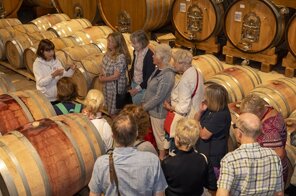
Our experiences will take you through wineries, vineyards and guided tastings, allowing you to discover the island's wine regions and meet the people who bring them to life.
.jpeg)